War causes social breakdown, allows us to be worse than animals, and to get away with it

I decided to go into war prevention because I suspected it was not cost effective and because it creates a generation of people wanting vengeance.  The Iraq War was sold to us as a great way to make money from reconstruction (by destroying what already existed), to support international development (i.e. take their oil industry) and produce peace (by turning a militarised country into a terrorist region).

What I have since learned about is some of the human cost.  I had some idea, of course, but there are murkier aspects that do not get talked about.

One example is male sexual abuse.  I did not think it likely to be a big deal: rare and hardly very damaging.  All a bit “Fnarr, fnarr, you’ll get over it.”  I was very wrong.

The scale of the problem and the nature of the physical damage to the body are described in this Guardian article from 2011 entitled The rape of men: the darkest secret of war.

I wanted to cherry-pick some quotes about the marital breakdown, humiliation, physical consequences of the permanent damage caused, lack of support and lack of recognition, but the article itself if pretty relentless in providing these itself.  Essentially, it is not about sexual gratification, it is about the perpetrator being so dehumanised that they routinely perform the most degrading torture on innocent strangers and war both creates the environment for such cruelty and makes it possible to hide the act both at the time and later.  If interested, I suggest you read it for yourself.  It’s all quite sad.

I thought Sven Hassel’s books about what went on at the Eastern Front were bad; reality is worse.

War causes social breakdown and allows us to be worse than animals and get away with it.  It makes one wonder what the agenda is for those people who promote it.
Wars cause terrorism and make people rich

In a discussion about removing civil liberties to combat terrorism, I liked this comment:


If we did not openly and actively sponsor fanatics waging civil wars on the Russian periphery and in the Middle East for the last 20 years the AK47s (actually, most of them are AK72 nowadays) would not have been there to be sold in the first place.

.. and nobody would have made a bean off arms deals.

Wars are simply there to convert tax money into private income without too many questions asked – profit is the cause of war. The rest is IMHO just camouflage and fluff to hide the bigger picture.


It is time for war to become an anachronism

Slavery was normal.  It is now (mostly) history and we find it abhorrent.

Duelling was common.  It is a historical curiosity and only exists in old Western movies.

People claimed smoking was good for curing lung ailments.  We now know that was nonsense.

Dog fighting and cockfighting were commonplace.  Most people now find such bloodsports appalling.

Executing criminals was common.  Now capital punishment is known to be an ineffective deterrent, is cruel and all too often was done to innocent people.

Public executions were popular entertainment.  The few remaining countries that do execution now usually do so in private.

Corporal punishment for children was common in schools.  Now beating children is illegal.

Child labour was normal.  Now we value an education as more important.

When will we realise sending people to kill other people is a rubbish way to solve national differences, and consign it to the history books?

War and Peace in the Lonely Planet

Just reading the Lonely Planet guide to Scotland’s Highlands & Islands and a couple of lines stood out.  Firstly, about violence:

The Vikings were probably no more blood-thirsty than the Romans, Picts or Celts, but they made the fatal public relations error of attacking the monasteries, which produced all the history books from the medieval period.

Alternatively, it could be they had a reputation for brutality because they attacked the monasteries; and it wasn’t a bit of light shop-lifting from the monastery visitor centre shop.  Top tip to modern day marauders: stop destroying religious sites, it gets you a bad name that lasts quite a long time.

Secondly was about the construction of roads into the Highlands as part of the suppression / taming (choose your own standpoint) of the clans:

New military roads were driven through the glens and garrisons were established…  As a side effect, the new roads increased trade between the Highlands and the lowlands, reducing the traditional suspicion of Highlanders in the lowlands and exposing the Highland clan leaders for the first time to the wealth of the lowlands.

So, from this interpretation communication and trade finally brought peace in Scotland.  I wonder what high speed rail links and motorways into Afghanistan and the Middle East might achieve.  Form—or find—the Afghanistan Tourist Board, tell people what to visit, and communication and trade will increase.  So will understanding.  People are already going, and it’s not as bad as it was.  And here’s what the Lonely Planet web site has to say about it.

Meanwhile, the gov.uk web site says:

The Foreign and Commonwealth Office (FCO) advise against all or all but essential travel.

with the latest bad news being from three days ago ‘13 May 2015 – an attack on a guesthouse/ hotel in Kabul‘.  What to do?  Leave them to their own devices, or go and buy trinkets and see one another as just people.  It reminds me of growing up in London when there were no tourists—except the brave Japanese, of course—because of the IRA.  England was seen as far too dangerous to visit.

I wonder where the reality lies?  And is the risk to the individual outweighed by the benefit to world peace?

Tiresome security vulnerabilities and wannabe l33t h4ckerz

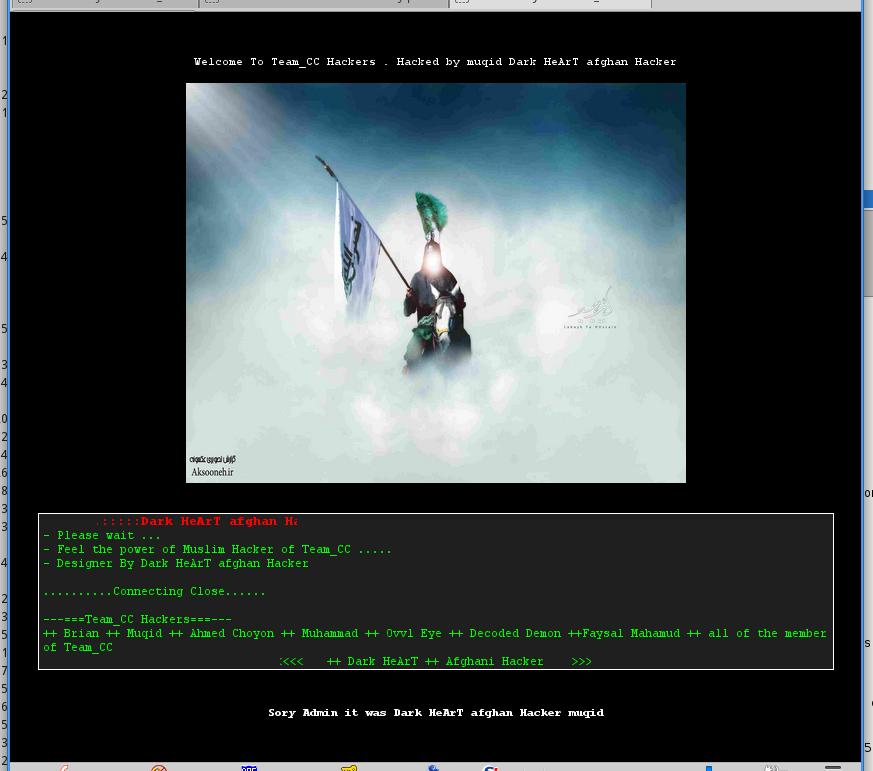
The 11112018 organisation web site got hacked last week.  Some child replaced the site with a pro-Islamic page that boasted of their l33t h4ck1ng skillz and claiming to be an Afghanistani member of a hacker team:

Screenshot of the hacked 11112018 web site

Hacked 11112018 web site

Meh.  The page was the sort of thing one saw on bulletin boards back in the early 1990s with a link to an (uncredited) image of a Moslem knight.

It is a shame that in doing so, they trashed the 11112018 anti-war web site. How to make friends and influence people, not.

They managed to do so because I had not applied an update to the Drupal web content management software I was using; the version had a security vulnerability this person took advantage of.  A quick Google search shows they have uploaded identical content to over 700 web sites.

What amazes me is the poor quality of their work.  The HTML is full of stupid errors that shows the child responsible did a simple cut ‘n’ paste of downloaded code into existing HTML without knowing what they were doing.  It also includes embedded JavaScript, some of which does not execute at all because it is incorrectly implemented.  The layout of the HTML also demonstrates a total lack of understanding of what they were doing.

This is the technology equivalent of putting sugar in someone’s petrol tank or letting their tyres down.

(But they were unwise to leave log file traces, names, IP addresses, traceable script and a trail of identical destruction to other web sites online.)

My To Do List for June included replacing Drupal with something else and putting up a load of content onto the 11112018 organisation site.  Well, now it seems I’ll be replacing the site completely.  Time that would have been spent working on peace studies and pro-peace activity.  But now with slightly less motivation than I had before.

Although I could claim “Hey, I’ve arrived!  A pro-Islamist activist group have targeted my peace web site for taking down and replaced it with their messages of hate!”  But the reality is they have an automated script that just trawls the domain lists for sites due for renewal and searches for this specific vulnerability, then automatically applies their—rather awful—content.

They have just as mindlessly replaced a web site for childcare and a children’s skateboard park web site.

It’s just the same childish, mindless vandalism as spraying swastikas on bus shelters.

I am so disappointed.

Searching for peace sector jobs

It can be difficult finding jobs in any sector, but searching for those relating to peace has extra problems.  For example:

  • Just what is the sector called?
  • What qualifications can one search for?
  • What licensing requirements can one search for?

A search for ‘peace’ on the UK government’s job web site Universal Jobmatch highlights these problems for those wanting paid work working for peace:

  • Agencies who include ‘peace of mind’ as boilerplate text in every advert such as:
    • Our aim is to ensure that people have a job that is satisfying and rewarding, which in turn gives clients an enhanced service, as well as total peace of mind” (for a Healthcare Assistant role);
    • Our 20 year “Total Peace of Mind”guaranteeprovides a unique offering and we have RECC membership, MCS accreditation and a financefacility” (for a solar panels sales role for a company that cannot find the keyboard’s space bar);
  • Arbitrary use of ‘peace’:
    • Northampton is a thriving, colourful and developing town that offers affordable housing and is situated in Northamptonshire, and offers the restful peace of the countryside” although how a city of ¼ million people counts as ‘countryside’ I don’t know and there hasn’t been any affordable housing in Britain for over 30 years;
    • Youll be at peace developing cross-browser AJAX web applications” for a ‘C / ASP .Net Software Developer’ meaning the candidate will be told to do stuff they are not qualified to do but won’t complain;
  • Using ‘peace’ to mean the opposite of peace:
    • Ministry of Defence, Unit Photographer.  Provide photographic images to support, enhance, train and protect the unit’s reputation during times of conflict and peace” (note I had to correct the grammar in that advert);
    • WTF is a ‘Protection Insurance Adviser‘?  Isn’t that what the Mafia use to run their protection rackets?  “As a Protection Adviser you will be on hand [fist?] to recommend the very best suite of protection insurance products to our clients to give them peace of mind“;
    • For the peace of mind of our customers and our colleagues, we will carry out screening checks as part of our recruitment process” when they really mean their own security;
  • ‘peace’ in the recruitment agency’s name, such as Peace Recruitment who work “within the construction, property and engineering sectors” — so why are they called Peace Recruitment? (they currently need bricklayers in Edinburgh, BTW);
  • employers with ‘peace’ in the name such as GreenPeace who are recruiting door-to-door fund-raisers (“FULL INSPIRING TRAINING GIVEN“, poor sods) and chuggers which, in my book, is about as peaceful as a smack in the mouth;
  • companies oddly using WW2 to define their age:
    • a bus company: “through wartime and peace, we have improved the day-to-day lives of generations of people” !;
  • roles requiring a Moslem and so tangentially refer to ‘peace’, such as:
    • Imam.  Provide Islamic guidance according to Mohammad (peace and blessings of Allah be upon him)“.
  • roles with a peaceful environment, which are a nice distraction to read about, such as:
    • Greenkeeper.  For those seeking peace and quiet, the site also offers solitude and privacy” – lovely;
  • recruiters such as Leah Peace who have ‘peace’ in their given name, with which I cannot get upset;
  • jobs where the word ‘peace’ does not appear anywhere, which are just a mystery.

But most of them are sales jobs selling insurance as ‘peace of mind’, meaning ringing people up and frightening them until they give you money.  How is that promoting peace in society?

It seems the people who want to be associated with the word ‘peace’ in their advertising do so because they are so far detached from the concept.

Of the 584 jobs returned today, two are actually related to peace: a lecturer and a research analyst.

From the above analysis one can assume that if you want to work in the peace sector, the odds are over 200:1 against success when searching for ‘peace’.  So a bit like real life, then.

The horrors of war: the gueules cassées

I believe gueules cassées is French for ‘broken faces’ or ‘broken jaws’ (I know not which) and is the term used for the French men who had their faces blown off in the Great War.

Some 15 million men were crippled by the Great War.  In the UK alone by the late 1930s there were still over half a million men receiving pensions for physical disability caused by that war (National Archive).  And then there were those who remained in hospital for the rest of their lives.

The nature of trench warfare is such that the face is often the most exposed part of the body meaning the Great War – with its shrapnel and grenades – was the cause of a huge increase in the number of severe facial wounds.  Also, battlefield medicine began to improve during that war increasing the likelihood of wounded men surviving terrible wounds that would have previously been fatal.

But what happens to a young man with no lower jaw or a hole in his skull where his nose was?  And in France losing ones face was not considered a disability so they received no pension, despite being unable to go out in public.

Léon Dufourmentel (1884 – 1957) was a French surgeon responsible for caring for the gueules cassées and was innovative finding methods for repairing facial wounds by transferring flaps of skin from the scalp to, for example, the chin.

Apparently five of his patients were taken from the hospital to the Palace of Versailles for the signing of the peace treaty in 1919.

Such people are still supported in France – because soldiers are still being shot in the face – through the Union des Blessés de la Face et de la Tête (Union for those with Facial and Head Injuries) and the Foundation for Gueules Cassées are.  They organise international events to raise awareness and funding.

Whether you choose to do a Google image search for the term is up to you.  They are seriously horrid pictures.  They are the sort of images the media are prevented from portraying during a war for fear of upsetting morale.  Whether you call that sensible censorship or propaganda is up to you.

Alternatively view the war memorial in Trévières to the dead of 1914-18.  She was herself maimed in the Second World War and now stands as an inadvertent representative of the broken faces.

The War Memorial at Trévières with her lower jaw blown off

The War Memorial at Trévières. Taken from Traces of War.com

As I write this, there is nothing on the English language Wikipedia about the gueules cassées.  Nowadays plastic surgery is commonplace, even expected of the rich and famous – every day the newspapers and news web sites are littered with such ‘news’.  But nothing much is said about those who suffered and made it necessary for innovative techniques in surgery to be invented.  Perhaps a little more exposure to the horrors of war, and a little less commercial censorship, rather than glorifying and sanitising war by  the media and search engines, might not go amiss.

Dinosaur poets

A fellow Open University student wrote in Dinosaur poets TM:

what is/are Poets

Can they die and emerge again

like Dinosaurians

?

which made me think of some of the First World War poets and haiku in response.

Brooke.  Grenfell.  Munro.
Owen.  Rosenberg.  Sorley.
Thomas.  Wilson.  Wyn. 

The Great War is history, and the poets above did not survive it.  But fragments of their work live on, typically preserved in stone, like the fossils of creatures who lived at a time before ours when great beasts roared across the earth, ripping gentler souls limb from limb in the quest for blood to spill and flesh to consume.

Which got me thinking about the metaphor of Hollywood B-movie dinosaurs as great monsters, roaring and killing like the great guns of the artillery blasting away at the soldiers in the trenches.

Children love to see reconstructed dinosaurs and stomp about roaring and pretending to be a T-Rex, chomping great chunks out of authority figures like parents and teachers and elder siblings.  Being so big and powerful that they can do as they like, ruling the earth.

Is this the childish, base desire that prompts people to like to watch war being made on the news?  Gore-porn as entertainment?  How advertisers are clamouring to get their products promoted alongside clips of people being beheaded, blown up, burning alive, shot and gently rotting in the sun?  The advertisers and media know what we like.

Civilisation is a transparently thin veneer.

“What’s the European union and why do we keep hearing about it?”

Another answer to a query from an aspiring author.

RJ: “What’s the European union and why do we keep hearing about it?”

Are the British Isles part of Europe, or some independent islands in the North Atlantic? What looks like a geography question is really a socio-economic question: do we want to be part of of Europe?

Firstly, what do we mean by “Europe”. Currently, that appears to be something called the “European Union”.

After a century of fighting Germany in ever expanding wars, in 1951 France formed the European Coal and Steel Community with them plus Belgium, Italy and others to pave the way for international co-operation that would make future central European war both unnecessary and undesirable.  And right there is a great example of an alternative to war being implemented.

This expanded in scope to include atomic energy and governance to produce, in 1957, the Economic European Union or EEC. For many years we debated in Britain: should we join the EEC? It was a difficult question because of the fear of loss of sovereignty.

The original French vision had been to create a single Europe with one government, one defence force, one agricultural policy and so on. This vision was quashed back in the 1950s by the founding countries as they feared the consequences of it and it seems they still don’t want it. It may have meant the loss of cultural heritage, loss of control, failure to recognise differences in values and loss of identity.

These concerns are what put us off: would be be forced to eat garlic sausage and other foreign muck, like snails?

In 1973, we took the plunge and joined. We immediately stopped driving on the left, started speaking French, began eating frog’s legs and stopped buying beer in pints. Well, maybe not. But there were changes, especially around trade, travel and the legal system.

This became the European Union in 1993 when we signed the Maastricht Treaty. Amazingly, this got little press at the time but it is one of the most significant events in British history. We also do not notice the changes it brought about.

Anyway, the European Union is the current name of this ever expanding organisation (although some surprising previous members have left, such as Algeria and Greenland). It expands both geographically and in scope and so is ever changing. And nobody enjoys change.

But after 40 years of membership we still drive on the left, don’t like garlic sausage, still can’t speak anything other than English and measure distances in miles.

So back to the question. “Do we want to be part of of Europe?

We’ve identified “Europe”, but who are “we”? Ireland wants in. Scotland, traditionally allied with France against England, wants in while nearly being out of the UK. Wales can’t make its mind up. And England? Who knows?

All you need to do is predict the future, and the answer to the in/out question will be clear.