UK aid from 0.7% to 0.5%

There has been a UK government announcement about reducing aid from 0.7% to 0.5%.

The argument is that since the economy is struggling1, we ought to spend less on aid (“charity begins at home” and all that). But the idea of paying a percentage is that is goes down when the economy is suffering anyway. So reducing the percentage reduces the amount twice over. Also, since the economy has shrunk, reducing the %age spent on aid claws back less money than it first appears, it claws back 0.2% of less that it would have.

Of what is it 0.7% or 0.5%?
It is a %age of the Gross National Income (GNI). What is GNI? That is the new term for Gross National Product (GNP) which is in turn a slightly tweaked version of the Gross Domestic Product (GDP). The GNI is as near as damnit the same as GDP. The GDP is all the goods and services we make in the UK, so the aid budget is a proportion of that. GDP is about £500 billion, so the aid budget is about

In 2016, the UK spent £13.4 billion on overseas aid.
In 2019 the aid budget was about £15.2 billion.

Why 0.7%?
0.7% is the UN’s target for all developed countries and has been since 1970.
That was a commitment from nine members of the Organisation for Economic Co-operation and Development’s development assistance committee.
The UK government signed up to the target in 1974 but it only achieved it for the first time in 2013.
In 2015 it was put into UK law.

How much is it going down?
It is expected to go down by £2.9bn due to the decrease in the economy, to £12.3 billion and the reduction to 0.5% will bring it down to about £8.8 billion. An overall reduction of about 42%.

What has the government said?
The government announcement said that aid will be combined into diplomacy. That suggests it will not be spent on the items it was spent on. Instead it will go to:

  1. fund climate change related activity in developing countries;
  2. spending on Covid-19 measures in developing countries;
  3. education of girls;
  4. an umbrella of measures in health (is also item 2), education (is also item 3), resilience (is also item 5), low carbon tech (is also item 1), agriculture [probably what everyone thinks of as sustainable aid], economic development (is also item 7), conflict (is also item 6) and poverty [the other view of aid as unsustainable];
  5. democracy and governance;
  6. international collaboration;
  7. trade and investment opportunities.

That sounds like some aid will be diverted to climate change, some to the Covid-19 expenditure, some to supporting other governments, some to supporting large international charities and some to compensating for leaving the EU.

They also said there will be performance assessment. This has been called for in the past but it is not yet clear how performance will be measured.

In his speech he talks mostly about the money going on climate change, military peacekeeping, cybersecurity,Covid-19 and education.  So there won’t be anything like so much spent on what people consider as ‘aid’, and what there is will be mostly diverted toward national security measures.

There was no reference to the Conflict, Stability and Security Fund, nor to the Stabilisation Unit.

Useful info:
– Full Fact UK spending on foreign aid 15 February 2018 fullfact.org/economy/uk-spending-foreign-aid

1  “The UK is facing the worst economic contraction in almost 300 years, and a budget deficit of close to £400 billion – double that of the last financial crisis” https://www.gov.uk/government/speeches/official-development-assistance-foreign-secretarys-statement-november-2020

Annoying having to log in twice

At some point in the past something changed. I’ve no idea what or when and it wasn’t something I did. But now when I go to log in I get:

wordpress login Error: cookies are blocked or not supported by your browser. You must enable cookies to use WordPress.

Logging in a second time works.

This gives me the creeps because it is identical to a particular method of stealing login credentials I worked out (and used!) when at college many years go.

Today I had the time to investigate it and, oh dear. It does depress me when I see an error has been around for years and has multiple solutions proposed. I just know it will take me hours to work it out and, no doubt, other things will break.

So, some hours later, I’ve edited the

EDIT: And now I can’t post properly either. It would not let me post the above and when I tried to retrieve it, half it it was lost.

I’ve applied updates, edited the php_config.php, updated php on the server, ensured I’m using an out-of-the-box theme, disabled plugins and done a health check. Now the site is complaining it is not using HTTPS so as well as the original problem, I now have a new one. Exactly as predicted.

A textbook on peacemaking?

One of the frustrations I felt travelling this path is the lack of an off-the-shelf textbook on “How to Do Peace”. Seeing a link to the Berghof Handbook for Conflict Transformation raised some hope. A single reference book is what I have hoped for.

“The Berghof Handbook for Conflict Transformation offers a continuously updated online publication platform for both academics and practitioners to review the state of the art, discuss new ideas and exchange experiences in the field of conflict transformation.”

No, it’s not a handbook, it is a web site of articles and downloads.

About the Handbook:
The Berghof Handbook for Conflict Transformation offers a continuously updated online publication platform for both academics and practitioners to review the state of the art, discuss new ideas and exchange experiences in the field of conflict transformation.

Seemingly useful should be the Berghof Glossary on Conflict Transformation and Peacebuilding which sounds promising ‘We first published this small and compact booklet as a guide to our interpretation of the cornerstones of peacebuilding and conflict transformation in 2012‘. However, it is ’20 essays on theory and practice’ in 170 pages. It may be useful, but it’s not really a glossary, is it?

It is another web resource of articles, not an off-the-shelf handbook which is what is needed by those wanting to participate.

We need more data on peace-making

Accept repentant Boko Haram fighters or they go back to terrorism, presidency urges Nigerians

This is a news story about young men who had been members of a terrorist organisation being allowed to repent, and the national leader asking people to allow them back into their communities.

19/09/2019 “the establishment of ‘Operation Safe Corridor’ in Gombe State has been described as a global model in combating insurgency in the world” link.

11/06/2020 “No repentant Boko Haram Terrorists combatant who has been reintegrated into the society will evade arrest if he reneged on the pledge” link.

Anyone who thinks one cannot negotiate with terrorists and one must fight fire with fire could do worse than look at Operation Safe Corridor. The deradicalisation, rehabilitation and reintegration (DRR) process of ex- Boko Haram members seems to have been a remarkably impressive demonstration of best practice in tackling extremist violence.

General Olonisakin: “the Armed Forces of Nigeria is not only trying to win the war but to also win the peace”.

It must be incredibly tough on those still displaced or still in areas affected by Boko Haram. Forgiveness does not come easily.

It’s quite an example though of how violent groups recruit and kidnap young people to do their fighting for them, and how such fighters themselves can also be the victims.

I’ve written before about trading justice for peace. Punishing these young men would have been injustice on injustice and not resulted in any peace.

Violence is complicated. Peace is really hard.

I do hope all this gets researched and documented. An observation:

“The operation Safe Corridor is good, but how much have been invested in communities to bolster their resilience capacities, heal their grievances and give them back their lives to enable them embrace these formers? What is the post deradicalisation programme that can effectively monitor these formers to track their progress in reintegration or further resurgence in their old tracks? What has been the role of formers in the process deracalisation or PVE? These and many more should be reassessed and appraised.”

Absolutely – data is needed and needs to be published about conflict interventions and resolution as a bigger picture. This was a major conclusion from my Master’s in Peace Studies – a lack of off-the-shelf case studies fro those new to or outside the field.

Essentially we have the Oxford Research Group’s ‘War Prevention Works : 50 Stories of People Resolving Conflict’ from 2001 and High Miall’s ‘The Peacemakers: Peaceful Settlement of Disputes Since 1945′ from 1992.

I think there is a desperate need for Practitioners’ Manual for Peace based on evidence from past interventions, which requires that consolidation of data to underpin and inform it.

I do find it interesting it appears to be being led by the Armed Forces of Nigeria. How’s that for defence diversification?

All quiet on the Western Front

Military clichés are everywhere.

Six months and no posts. Been too busy, too confused.

Could have written about the incredible blatant racism I have witnessed in Milton Keynes.
Could have written about job searching.
Could have written about working for the NHS during lockdown and going in to work every day.
The paranoia of people seeing my NHS id. This misleading and terror created by the media.
Reflections on how easy it was to implement a global lockdown.
Reflections on what happens when the leadership does not follow its own instructions and gets away with it.
Reflections on the relevance of Niccolò Machiavelli’s The Prince as a guide book in 2020.
Could have written about getting work with the Cabinet Office.
Could have written about my reflections on my two degrees.
Could have written about the silence of the 75th anniversary of the Japan nuclear bombings and the celebration of war for VJ Day.
Could have written about how my plans have been on hold for six months.
Could have written about how some employers have been superb during lockdown and others have been utter and absolute spineless and evil bastards.
Could have written about the falsehoods around online activity being high CO2 consuming activities. I had promised the SGR I would.
Every day there has been something to write about, and my ToDo list does say, every day, “Post something on the blog”. But time, where does it all go?

It is hard to be an unemployed jobseeker and be positive and creative to wrote blog posts. Then, when doing a new job, one is tired and busy.

It is hard to change the world when changing one’s own. It is hard to write when busy doing. I shall try again, from today, now I feel a little more settled in my new role.

You know, bite the bullet.

I struggle to understand how criminal damage and attacking people’s history is peace-making

I struggle to understand how criminal damage and attacking people’s history is peace-making.

I’ve just had a post through on the Networking for Peace mailing list: “Germany : Tear This Down – Eliminate Colonialism Now” which links to a site called TearThisDown.com (active link not provided on purpose). It provides a map of street names, monuments, stations and other public items named after people they disapprove of and demanding ‘TEAR DOWN THIS SHIT‘. They call for such monuments to be damaged, destroyed and have graffiti applied.

They clearly don’t care that people live in the areas where they intend to conduct criminal damage nor about the fear (and additional damage) it will create.

They clearly have not thought about social cohesion and how this kind of hate crime – which is what it is – creates divisions that will last far longer than the short-term fun and publicity they seek. This is not resolving differences, it is creating conflict.

This is a few people wanting to cause social upheaval and using it to raise mobs to go out and cause damage without consideration for knock-on effects and consequences is not making the world a better place. It is teaching people that anti-social behaviour is a good thing and that despising other sections of society and blaming them for acts that happened before they were born is progress.

It is just some people, fuelled by hate, creating power for themselves at the expense of others and getting other people to do their dirty work for them.

It’s just Kristallnacht in reverse.

I fail to see how this is appropriate as a “Networking for Peace” activity.

Ducks, planes, horses, teacups and tanks

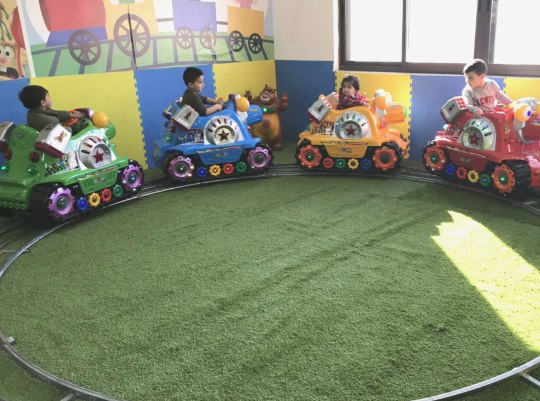
You must have been on a fairground merry-go-round as a child.  Was it a traditional carousel with horses that go up and down as it goes round?  Or a toddlers’ one with teacups?  Maybe it was zoo-themed with lions and zebras and elephants?  Emergency service vehicles such as police cars and fire engines?  Trains are quite common, such as a Thomas the Tank Engine themed ride.

Talking of tanks, how about this?

Image taken from Children in Peace site https://www.childrenofpeace.org.uk/news/

The campaigning body ForcesWatch worries about the militarisation of society in the UK, with lengthy arguments as to why it is not right to encourage guns as playthings.

But even they have not got started on the concept of toddlers in tanks.

UPDATE:

I did email Children of Peace and ask them via their contact form what that image was supposed to be.  I got no response.  Within a few hours they had changed the image on the news page.  I presume they have realised there are links to it and removed it from the media section of their site – hence it appears broken above.  This was the image:

This is the email I sent on 26th Jan 2020, as at 3rd Feb 2020 I have had no reply:

——– Forwarded Message ——–
Subject: A query regarding an image on your site
Date: Sun, 26 Jan 2020 17:02:26 +0000
From: Simon Reed
To: contact@childrenofpeace.org.uk


Can you tell me what is going on in this picture?

I am referring to the headline photo for the news story “/A new group joins us. The Palestinian group SHAMS joins us as an affiliate./”

It appears to be small children on a merry-go-round of tanks. It looks like one of the most appalling images of child military indoctrination I’ve ever seen.

What is the place and who are the children?


A cull of LinkedIn connections

After the USA’s extra-judiciary execution-by-drone in Iraq and the recent rejection of an extradition request, plus a radio interview with an ex-CIA director explaining (incorrectly) why torture of ‘assets’ is a legitimate and valuable tool, and their desire to increase nuclear weapons development, I am once again thinking the USA is a rogue state.  They can kill whoever they want wherever they want with impunity, and increase global fear, tension and risk.

So I have reviewed my LinkedIn connections looking for those in the USA.  On actually examining their profiles, an awful lot of them calling themselves ‘peaceworkers’ were either reiki consultants or military consultants.

So I have cleansed my list of connections by removing the dodgy citizens of that rogue state.  I feel less dirty because of it.

If not on the military, then what?

With regard to withholding military taxation such that it is spent on something else, a common challenge is “On what?

On the Beeb news it says “Australia bushfires: Fundraiser reaches A$20m in 48 hours“.  The Australian government spends that much on their military every 8½ hours.

That story also says “Prime Minister Scott Morrison has called up 3,000 reserve troops to help“.  That is 3.7% of their armed forces.  15% of their reserves (i.e. civilians being called away from their day jobs) and 0% of their active personnel.

If 3.7% of the Australian military budget was permanently re-allocated to fire prevention (as opposed to ‘Oh shit, the whole country is on fire, maybe we ought to act now‘), it would provide AUS$765,000,000 annually.  Nearly 40 times what has been raised from charitable giving to help save the country.

Australia spends just over AUS$1,000 per capita on militarisation.  The fundraiser is equivalent to 20,000 people’s military expenditure, about 0.078% of the population.  Military expenditure is 1.9% of GDP and 5.1% of government spending.

Perhaps Australia should spend a bit less on battle tanks and a bit more on the land they drive around on.  The Leopard tanks they had from 1976 to 2007 were never used.  They currently have 59 M1A1 Abrams tanks; these have also never been used.  They would like to increase that to 90.  Each one costs about AUS$13m.  Just ⅔rds of a fund-raiser each.